How much does site prep cost in Arkansas?
Site prep costs most homeowners $1,300 to $5,600, with an average of $3,800, says one national cost guide. That guide puts most jobs at $1.50 to $5.00 per square foot. Around Hot Springs, slope, rock, heavy rain and debris haul-off move the number most.
What does site prep cost around Hot Springs?
One national cost guide, updated May 30, 2026, puts most site prep jobs at $1,300 to $5,600. Its average is $3,800. Lot size and terrain move the total, and so does the list of jobs your site needs.
Scott Bankhead Demolition handles grading and site prep around Hot Springs with tracked excavators and dump trucks. The free on-site estimate turns these ranges into a number for your lot.
The same guide prices each site prep job on its own. It says a new home build will likely need clearing, grading and excavation, so the lines add up.
| Site prep job | National range | What the guide says it covers |
|---|---|---|
| Land clearing | $500 to $2,000 | Trees, brush and debris removed from the site |
| Grading | $1,000 to $3,000 | Ground leveled and sloped for drainage and stability |
| Excavation | $1,500 to $5,000 | Soil dug out for foundations and basements |
| Soil testing | $300 to $1,200 | Soil checked for stability, drainage and contaminants |
| Erosion control | $700 to $2,500 | Barriers or plantings that keep soil from washing away |
| Gravel or concrete pad | $1,200 to $4,000 | Listed as an add-on to the site prep job |
These are national market ranges for planning. A wooded lot needs land and lot clearing before the grading starts. Steep or rocky ground can push a row higher.
What does grading cost per square foot, per acre and per hour?
A second national cost guide puts land grading at $500 to $5,000 on average. By area, it runs $0.40 to $2.00 per square foot, or $17,400 to $43,600 per acre. Leveling a quarter-acre home lot runs $4,400 to $10,900.
Regrading next to a house is a smaller job. The same guide puts one side of a house at $500 to $1,000. Regrading around the whole house runs $1,000 to $3,000.
Some jobs bill by machine time instead. An excavator with an operator runs $100 to $300 an hour, the guide says. Hiring an operator without equipment costs $50 to $150 an hour.
Most operators charge a minimum of one day, or eight hours. At $100 to $300 an hour, that day comes to $800 to $2,400. A short job still pays for the full day.
Excavation runs $2.50 to $15.00 per cubic yard in the same guide. Cutting down a high spot and loading out the dirt is excavation and dirt work.
What does a house pad or a mobile home pad cost?
A pad is the flat, firm ground a home sits on. One national cost guide puts a foundation pad for a new home site at $1,500 to $10,000. The gravel or concrete pad add-on in the table above runs $1,200 to $4,000.
Code shapes part of that cost. Arkansas uses the International Residential Code as Volume III of its Fire Prevention Code. Its section R506.2 says the area inside the foundation walls must have all vegetation, topsoil and foreign material removed.
Fill under a slab must be free of vegetation and foreign material too. Unless approved, compacted fill is limited to 24 inches of clean sand or gravel, or 8 inches of earth. Stripped topsoil gets spread on the yard or hauled off the lot.
Drainage is the other code line. Section R401.3 calls for at least 6 inches of fall within the first 10 feet from the foundation. Where lot lines or slopes block that fall, drains or swales carry the water away.
HUD’s installation standard for manufactured homes, 24 CFR 3285.203, sets its own drainage rule. The site must drain surface water away from the home. The slope is at least half an inch per foot for the first ten feet. That is 5 inches of fall in all.
Scott Bankhead Demolition preps and grades house pads and builds gravel pads for manufactured homes. Budget the installer who sets a manufactured home, any concrete slab, and septic and utility work as separate lines.
Why do hillside lots around Hot Springs cost more?
Slope adds machine hours. A hillside lot needs more cut and fill to make a flat pad. Rock under the surface slows the dig. On an hourly job, every extra hour shows up on the bill.
Rain adds risk. NOAA’s 1991 to 2020 normals put Hot Springs at about 58 inches of rain a year. May is the wettest month at 6.51 inches, and August is the driest at 3.60.
Bare dirt on a slope is what heavy rain carries off first. Erosion control, such as barriers or plantings, holds it in place. One national cost guide prices that work at $700 to $2,500.
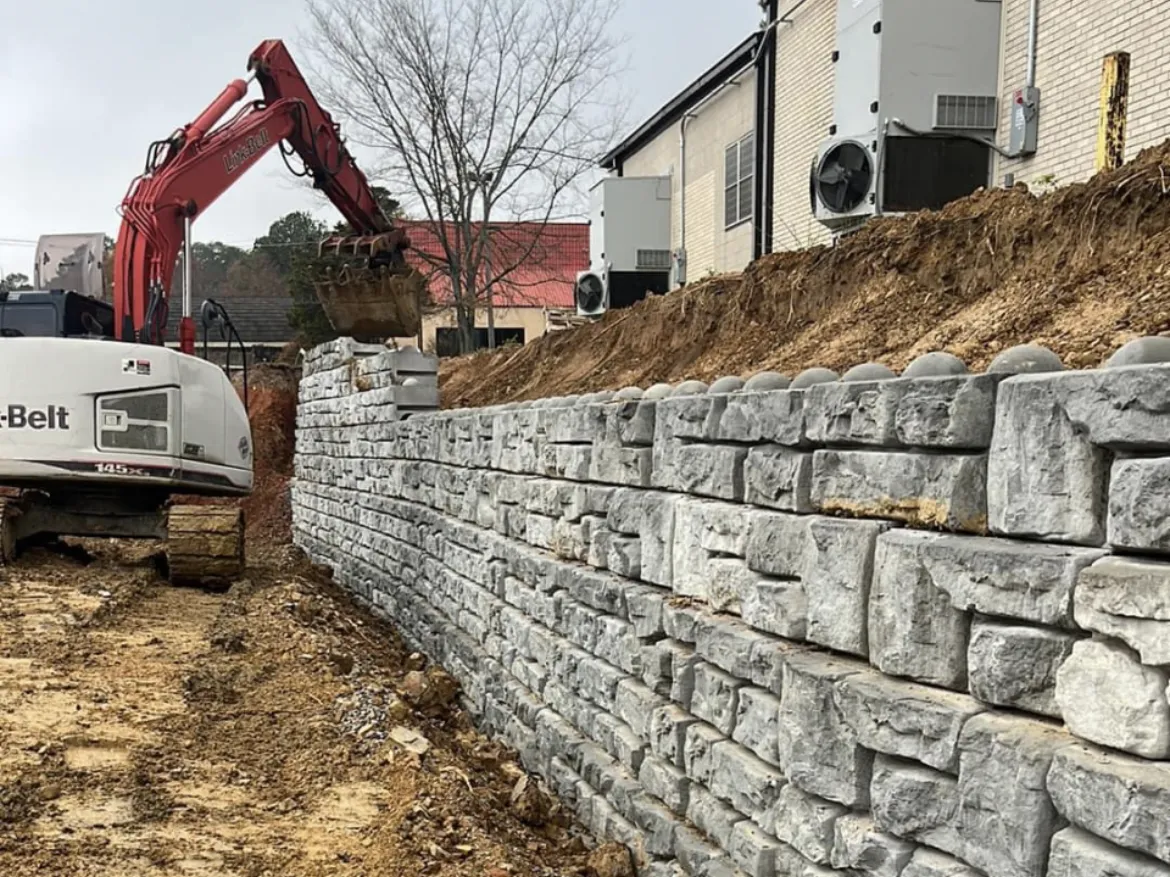
A tall cut may need a wall to hold the bank. Scott Bankhead Demolition builds large segmental-block retaining walls for that job. Where runoff crosses a drive at the road, a culvert carries it under. That is part of our drainage and culvert work.
Which permits does site prep need around Hot Springs?
Inside Hot Springs, excavation or grading needs a permit from the city engineer. An isolated, self-contained area of half an acre or less is exempt, if no danger to property is apparent. The fee depends on acreage and on whether plans are required.
| Permit | When it applies | Published fee |
|---|---|---|
| City grading permit, no plans | Grading inside Hot Springs | $50 under 1 acre; over that, $50 plus $25 per added acre, up to $275 |
| City grading permit, engineered | Plans required | $100 under 1 acre; over that, $100 plus $50 per added acre, up to $550 |
| Grading permit, national average | For comparison | $150 to $485 |
Land disturbance between 1 and 5 acres also needs a city stormwater permit. Over 5 acres, the job needs a state permit as well. Work next to a water body needs the city permit at any size. In another town, ask its city hall what applies.
Outside city limits, Garland County generally does not have building codes and issues no building permits. It does require a stormwater pollution prevention plan, or SWPPP, with a stormwater permit for some jobs. That covers work disturbing more than one acre but less than five in unplatted areas. It also covers any lot in a platted subdivision.
Two calls come before the first bucket of dirt moves. Inside Hot Springs, the Utilities Department asks for a call before excavation or land grading. That covers any site with water or sewer service.
Everywhere in Arkansas, state law requires contacting Arkansas 811 before digging. Dial 811 or 1-800-482-8998.
What happens to the dirt, stumps and brush?
When the cut and the fill balance, less dirt has to be bought or hauled away. Fill hauled in is priced by the yard and the truckload in our fill dirt cost guide.
Stumps come out with a tracked excavator. They get hauled off, and the holes get backfilled with dirt. That is our stump removal work, and it keeps roots out of the pad.
Garland County publishes its landfill rates. Class 4 construction and demolition waste runs $32 per ton, with a $15 minimum charge. Yard waste, meaning lawn debris, brush and wood under 4 inches, goes in free on unmixed loads. The county transfer stations do not take yard waste, so it goes to the landfill.
Our dump trucks haul the debris off. Fill and gravel come back in through fill dirt and gravel hauling. Clearing costs by the acre, and the state rules for burning brush, are in our land clearing cost guide.
Slope and soil set the real number on every lot. Scott Bankhead Demolition gives free on-site estimates on site prep around Hot Springs. Call (501) 617-1511 or ask for a free site prep estimate.