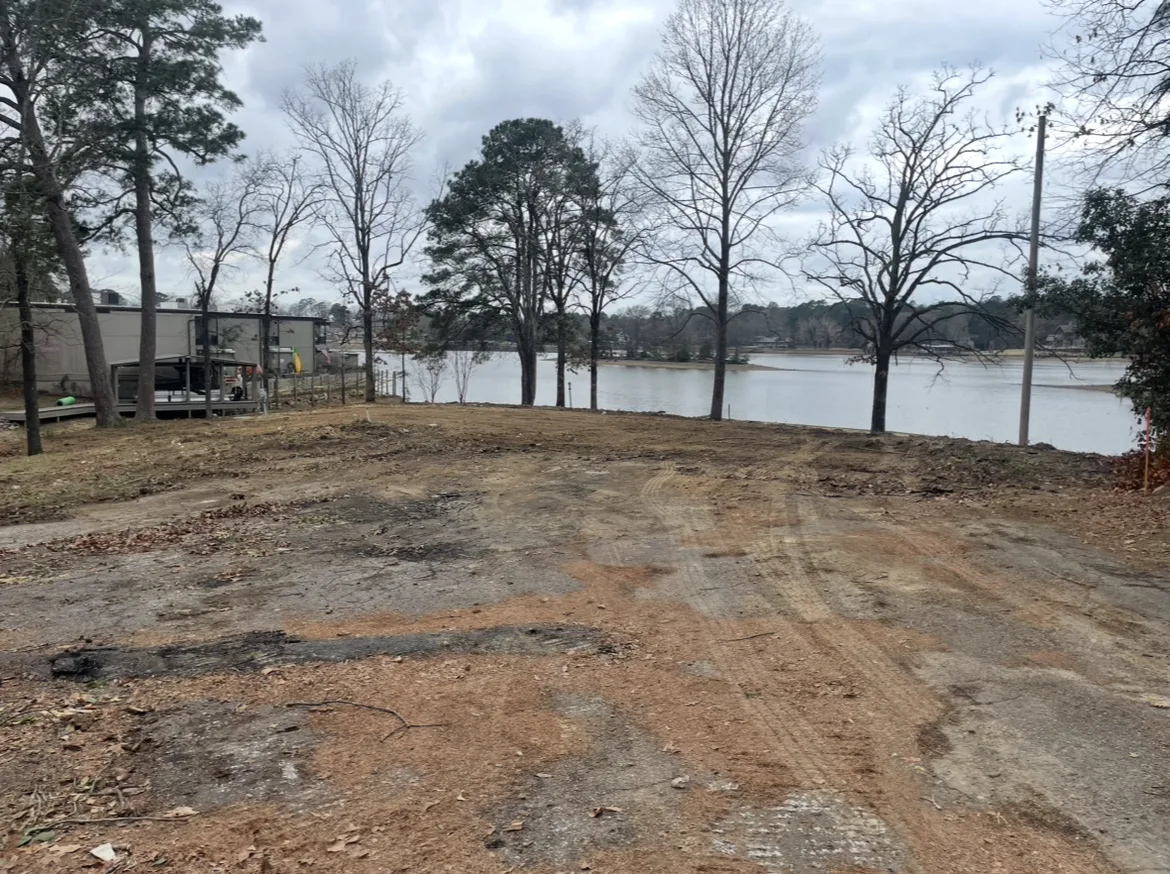
How much does land clearing cost per acre in Arkansas?
Land clearing in Arkansas runs about $1,200 to $8,000 an acre in national cost guides. Where your lot lands depends on tree size, slope, rock and how the debris leaves the property. Brush-only acres sit near the bottom. Heavy timber on a steep Ouachita hillside sits near the top.
What does it cost to clear an acre around Hot Springs?
Around the Hot Springs area, clearing an acre typically runs $1,200 to $8,000 in national cost guides. One 2026 cost survey puts the professional range at $1,396 to $6,174 an acre. Brush-only acres come in far lower. A tight, heavily timbered acre with stumps and haul-off sits at the high end.
Published guides split those ranges by what is standing on the lot when the machines arrive.
| Land condition | Market cost per acre | What that range covers |
|---|---|---|
| Brush and scrub, no trees | $330 to $630 | Cutting and removing brush only |
| Lightly wooded | $733 to $2,500 | Underbrush and small trees, no grading |
| Moderately wooded | $2,500 to $4,500 | Thicker underbrush and medium size trees |
| Heavily wooded | $3,395 to $8,000 | Dense cover and large mature trees |
| Clearing plus grading and site prep | Add $670 to $5,500 | Grading, excavation, permits and soil testing |
Those are published market ranges, not a quote. Acreage by itself does not price a job. Per acre cost drops a little as the tract gets bigger. The machines move in once and stay put.
A real number comes from a free on-site look at the trees, the slope, the soil and the access. That is where our land and lot clearing work starts.
What makes one lot cost more than the next?
Tree size, slope, rock and access move the price more than acreage does. Hardwoods take longer to cut and haul than pine of the same size. Steep ground slows the machines down, and wet clay can stop work for days. A lot with one narrow way in costs more than an open field.
Rock is the quiet one. Boulders hidden under brush add work. Large rock can need excavation before anything else happens. That is one reason a land clearing estimate around Hot Springs starts with a walk of the lot.
Weather is the other one. NOAA normals for 1991 to 2020 put Hot Springs at 57.96 inches of rain a year. May is the wettest month at 6.51 inches. Rain and soft ground delay progress and make a site unsafe for heavy equipment.
Dry stretches are when tracked excavators do their best work on a hillside lot.
Where do the trees, brush and stumps end up?
Most of the wood and brush leaves on a truck. At the Garland County Landfill, yard waste means lawn debris, brush and wood under 4 inches. On unmixed loads that costs nothing. Anything larger or mixed goes across the scales by the ton.
Debris volume is a real line in any clearing price. County ordinance sets the rates. Class 4 waste, the construction and demolition class, runs $32 per ton with a $15 minimum charge.
Class 4 waste brought in from outside Garland County runs $50 per ton. The county transfer stations do not take yard waste at all, so clean brush goes to the landfill itself.
Stumps are their own item. We dig them out with a tracked excavator and haul them off with the wood. Then the hole gets backfilled. That is a different job from leaving a stump in the ground.
Our stump removal page covers how that works. The wood and the root balls ride out on the same dump trucks that bring fill dirt back in.
Can you burn the brush instead of hauling it off?
Burning is the landowner’s call, and Arkansas puts rules around it. State law covers anyone burning forest vegetation, including debris from land clearing. You notify the state forestry agency of the time and location. The landowner or the person in charge of the land has to be present during the burn.
That notification rule kicks in once the material to be burned weighs at least one ton. Open burning of yard waste is carved out of it. Burns get reported in advance online or to the Forestry Division dispatch center at 1-800-830-8015.
Then there is the ban. Unincorporated Garland County has been under a burn ban since August 14, 2026. That is Executive Order CC-26-136. The City of Hot Springs has its own burn ban alert posted.
Open burning is prohibited until conditions improve. Check both before you plan a pile. A dry fall can hold a ban in place for weeks.
Is it worth selling the timber before you clear?
On a small lot, usually not. Timber sells by the ton as standing stumpage, and the statewide averages are modest. Arkansas pine sawtimber averaged $24.60 per ton in the first quarter of 2026. Pine pulpwood averaged $3.72 per ton and pine chip-n-saw $13.90.
Mixed hardwood sawtimber averaged $37.69 per ton over the same quarter. Hardwood pulpwood averaged $7.51 per ton. Those are statewide averages that may not reflect one particular tract. A few big pines on a residential acre will not move that needle.
The Extension report notes another problem. Sub 100 acre pulpwood stands are not feasible for many loggers to cut.
If you hold real acreage with sawtimber-size pine, a professional forester can run the sale first. On a one or two acre house lot, the practical plan is to clear it and move on.
Do you need a permit to clear land around Hot Springs?
Inside the Hot Springs city limits, yes in most cases. City code says no excavation or grading without a permit from the city engineer. One exemption covers an isolated, self-contained area of one-half acre or less. There has to be no danger apparent to private or public property.
Fees come from the city schedule. A non-engineered grading permit is $50 under an acre. Over an acre it is $50 for the first acre plus $25 for each additional acre. That runs up to 10 acres and caps at $275 per permit.
An engineered permit with plans is $100 under an acre. Above that it is $100 for the first acre plus $50 per additional acre, to a $550 cap.
A separate city stormwater permit has its own triggers. It applies to any land disturbance between 1 and 5 acres. Over 5 acres, you need the city permit and a state permit.
Any commercial land disturbance needs it, regardless of size. So does any land disturbance next to a water body.
Outside the city, Garland County generally does not have building codes and does not issue building permits. A bill of assurance or restrictive covenants can still limit what you do. The Circuit Clerk at 501-622-3630 can search those. City permits can also reach into the one mile extraterritorial jurisdiction around Hot Springs.
Hot Springs Village has its own rule. On any sized unimproved lot, the POA requires a permit to cut anything over 3 inches in diameter. That is measured 12 inches from the ground, and trees get flagged for staff review. Permitting and Inspections answers at 501-922-5562.
Everywhere in Arkansas, state law requires contacting Arkansas 811 before any digging or demolishing work. Member utilities locate their lines within two full working days.
Is forestry mulching cheaper than clearing?
Per acre, yes. Forestry mulching averages $400 to $800 per acre in national cost guides, well under most clearing ranges. It cuts the standing cover down into a mulch layer that stays on the ground. Stump removal is a separate cost on top of it.
That suits trails, pasture and fire breaks. It does not hand you a building site. A mulched acre still has root systems under the surface. Chips sit where the pad needs to go.
Clearing takes the wood and the root balls off the property and leaves bare dirt you can work. From there the lot goes to grading and site prep for the pad and the drainage. Which one is cheaper depends on what the acre has to become.
Every acre prices differently once someone stands on it. The trees, the slope, the soil and the way in all set the number. Scott Bankhead Demolition gives free on-site estimates around Hot Springs, Hot Springs Village, Benton, Bryant, Malvern and Arkadelphia. Call (501) 617-1511 or send us the details of your lot and we will come look at it.