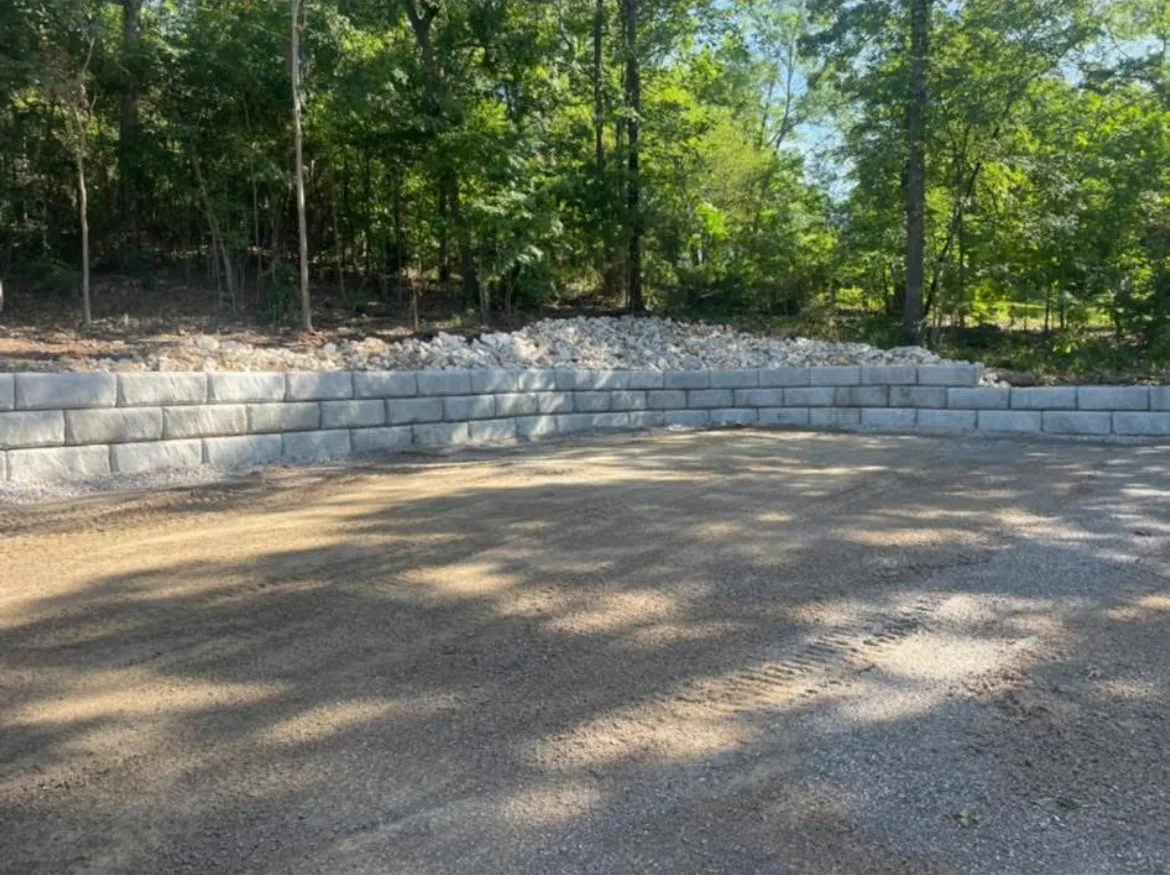
How much does a gravel driveway cost in Arkansas?
A new gravel driveway around the Hot Springs area usually runs about $1 to $10 per square foot installed. Public cost guides put most finished drives at $500 to $3,500. Driveway length and the dirt work underneath move that number the most. A free on-site estimate gives you the real one.
What does a gravel driveway cost around Hot Springs?
Most gravel driveways in this part of Arkansas land between $500 and $3,500 installed. One national cost guide prices the work at $4 to $10 per square foot. Others start lower, at $1 to $3 per square foot for simple drives on firm ground. Your ground decides where you sit in that spread.
The spread is wide because a driveway price is really two prices. One is stone. The other is the dirt work that holds the stone in place.
A short flat drive on firm ground needs little more than base rock and a top course. A long drive across a slope needs cutting, hauling and a crowned surface before any stone goes down. Both are new gravel driveways and driveway regrades.
Most projects in the national guides fall between $500 and $3,500, with an average near $1,800. None of those numbers have seen your property. A free on-site estimate is what turns a range into a price.
How much does a 100 foot or quarter mile gravel driveway cost?
Length sets the bill. One cost guide prices a 12 foot wide residential gravel drive at $5 to $10 per linear foot. That works out to about $500 to $1,000 for 100 feet and $2,500 to $5,000 for 500 feet. Tons of stone climb the same way.
| Driveway length (12 ft wide) | Square feet | Gravel needed | Installed range |
|---|---|---|---|
| 50 ft | 600 | 10 to 15 tons | $250 to $500 |
| 100 ft | 1,200 | 20 to 30 tons | $500 to $1,000 |
| 200 ft | 2,400 | 40 to 60 tons | $1,000 to $2,000 |
| 500 ft | 6,000 | 100 to 150 tons | $2,500 to $5,000 |
| 1,320 ft (quarter mile) | 15,840 | 265 to 395 tons | $6,600 to $13,200 |
Installed ranges use that $5 to $10 per linear foot. Tonnage uses a coverage of 60 square feet per ton at four inches deep. The high side uses 2.5 tons per 100 square feet at six inches.
The same guide prices a 12 foot wide road a quarter mile long at $15,000 to $60,000. Long drives carry the widest spread of any driveway job. The ground under them is rarely the same from end to end.
On a drive that long the stone arrives by the load. That part of the work is fill dirt and gravel hauling, dumped and spread where it goes.
What gravel do driveways in Arkansas use?
A driveway here is built in layers. The bottom layer is a crushed base rock the quarries sell as SB2 or Class 7. The top layer is a smaller crushed stone that locks together under tires. Market guides price base rock at $18 to $31 per ton. The depth of it decides how the drive holds up.
Class 7 is the ARDOT name for it. The state specification says Classes 7 and 8 are mechanically crushed natural rock quarried from solid rock. That is the same angular base rock a driveway wants under its surface stone.
Depth matters as much as the rock. Cost guides put the minimum at 5 to 6 inches, laid in layers. ARDOT builds its base in two or more layers once compacted depth passes 6 inches.
Prices move with the material. SB2 sub base runs $25 to $30 per ton and crusher run $24 to $34 per ton in the national guides. Crushed limestone, the clean stone sold as #57, runs $30 to $38 per ton. Pea gravel runs $28 to $45 per ton, and it is smooth, so it suits beds and paths.
Stone is sold by the ton and hauled by the truck. A tandem dump truck carries 10 to 14 cubic yards, or 12 to 18 tons. A 100 foot drive at 12 feet wide takes roughly two of those loads.
Why do hill country drives cost more here?
Water is the reason. Hot Springs averages 57.96 inches of rain a year, per NOAA’s 1991 to 2020 climate normals. May is the wettest month at 6.51 inches. Rain finds every low spot in a drive. A crown that sheds water and a ditch that carries it away keep stone where it was placed.
The lots around Hot Springs roll hard, and a drive often cuts across a slope. One side gets dug out and the other gets built up. That cut and fill happens before the first ton of rock arrives. It is where a hill drive earns its price.
Where the drive meets the road there is usually a ditch. Crossing it takes a pipe sized for the water coming down it. That pipe is a driveway culvert, and the county has a say in how it goes in.
Garland County has a rule for that connection. The county says to call the county road department about work on county rights of way. Drives onto state right of way go to the state highway department. The county road department number is 501-767-9174.
A drive that ties into a state highway is ARDOT’s call. Its permit page says an access driveway permit is required. That applies to homes and to businesses.
Digging also means a locate. The Arkansas Underground Facilities Damage Prevention Act requires a call to Arkansas 811 before any digging. Member utilities then mark their lines within two full working days.
Is a gravel driveway cheaper than concrete?
Yes, and the gap is large up front. National cost guides price a concrete driveway at $6 to $15 per square foot. A two car drive runs $2,400 to $8,600. The same guide prices gravel at $1 to $3 per square foot. The trade is upkeep, because gravel asks for fresh stone and a blade pass now and then.
Concrete lasts 30 to 40 years with upkeep. A well maintained gravel drive lasts 10 to 20 years. The difference is how they end. Gravel gets renewed a load at a time, while concrete gets replaced in one piece.
Cost guides budget $100 to $400 a year for gravel upkeep. Concrete runs several times more per square foot. That is why long rural drives here are gravel and stay gravel.
When does a regrade beat new gravel?
When the base is still good and only the shape is gone. If the surface is rutted but the ground under it is solid, a blade pass fixes it. A light top up of stone finishes it. Cost guides price adding gravel and grading at $50 to $450. Replacement is a different job.
Regrading and crowning runs $60 to $400 and resurfacing the top layer $50 to $450. Those figures describe small suburban drives. Scale them by length with the per foot rates above.
Full replacement runs $1,500 to $6,000. That is the call when a drive has deep ruts or a sub base that has quit holding. Water standing on a drive after rain usually points at drainage rather than at stone.
Cutting the crown back in and reshaping the ditch line is grading and site prep. On a tired drive that work often does more than another load of rock would.
Every drive prices differently, so the number that counts comes from looking at your ground. Scott Bankhead Demolition gives free on-site estimates on new gravel drives, regrades and pads. Call (501) 617-1511 or send us your driveway details.